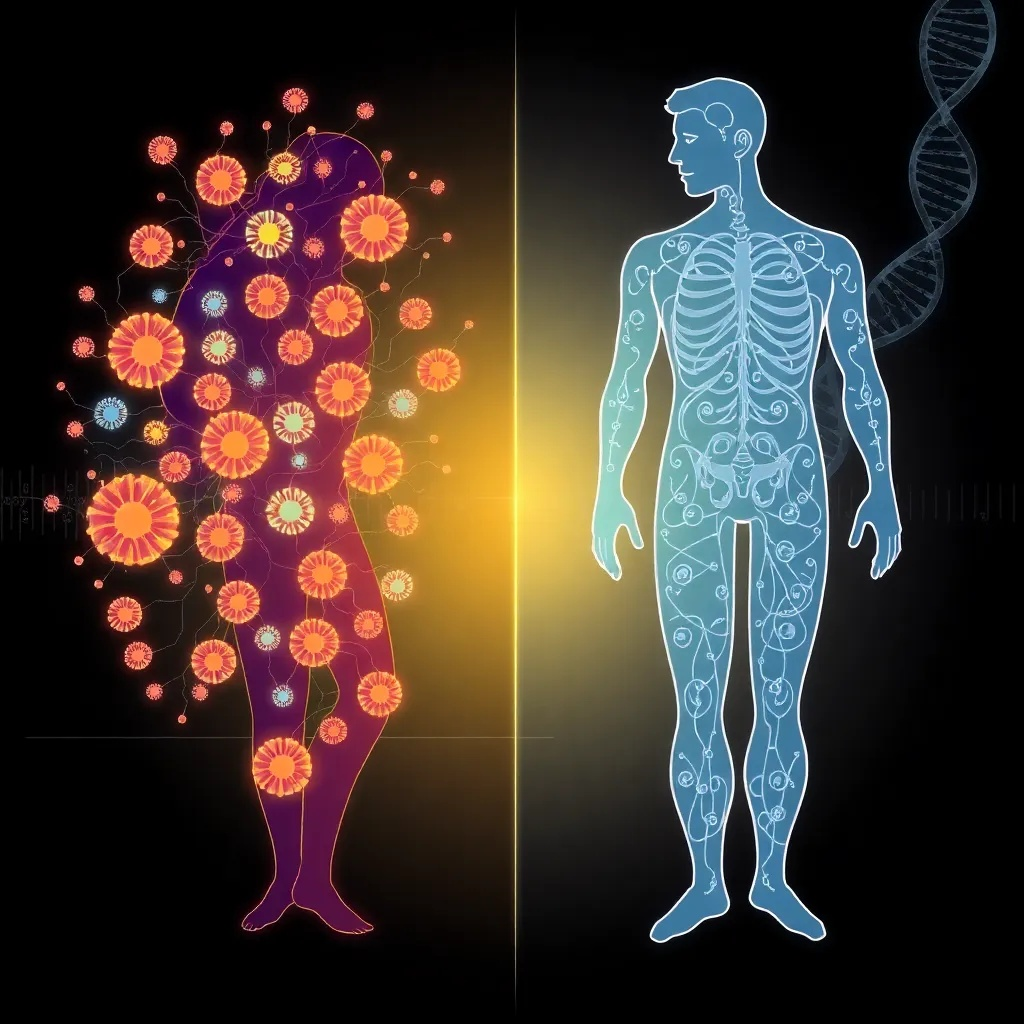
New research reveals how sex chromosomes and hormones dictate immune aging, explaining women’s higher disease burden despite longer life. Implications for personalized anti-aging strategies.
Biological sex fundamentally shapes how our immune system ages, creating a paradox where women outlive men yet face more chronic illness.
For decades, the morbidity-mortality paradox has puzzled scientists: women consistently live longer than men, yet they experience higher rates of autoimmune diseases, chronic inflammation, and age-related disorders. Recent breakthroughs in immunology are finally unraveling this mystery, revealing that biological sex—through chromosomes and hormones—programs two fundamentally different trajectories of immune aging.
The Chromosomal Blueprint: X Marks the Spot
At the core of this divergence lies the X chromosome. Unlike males with a single X, females carry two, and one is randomly inactivated in each cell. However, as a 2024 study in Science Immunology demonstrated, up to 23% of X-linked immune genes escape inactivation in aging females, leading to higher expression of key inflammatory and antiviral mediators. “This escape phenomenon is a double-edged sword,” explains Dr. Maria Torres, lead author of the study. “It provides enhanced protection against infections, but also predisposes women to autoreactivity.” The X chromosome houses over 1,100 genes, many involved in immune regulation, including TLR7 and TLR8, which are critical for viral recognition.
Estrogen’s Dual Role: Guardian and Provocateur
Estrogen, the primary female sex hormone, exerts profound effects on immune cells. It enhances the function of dendritic cells and B cells, promoting robust antibody production. A 2024 Nature Aging study found that female-specific B cell subtypes decline at a slower rate, maintaining broader immunity into late life. Yet estrogen also amplifies toll-like receptor (TLR) signaling, increasing the risk of chronic inflammation. Dr. Li Wei, a gerontologist at Stanford, notes: “Estrogen keeps the innate immune system in a heightened state of readiness, which is beneficial for acute threats but can backfire over decades, contributing to atherosclerosis and rheumatoid arthritis.”
Testosterone: The Accelerator of Immune Senescence
In contrast, testosterone, which declines with age in men, correlates with a shift toward pro-inflammatory cytokine production. Male immune systems rely more on a robust but short-lived adaptive response. A 2025 preprint by the Leibniz Institute on Aging tracked telomere attrition in immune cells and found that sex-specific shortening rates predict differential aging trajectories. “Men start with a stronger acute response, but it burns out faster,” says Dr. Karl Schmidt, co-author of the preprint. “The loss of testosterone with age removes a brake on inflammation, accelerating immunosenescence.” This pattern aligns with the higher incidence of severe infections and faster decline in vaccine efficacy observed in elderly men.
Adaptive vs. Innate: Two Paths to Decline
The adaptive immune system—T and B cells—ages differently in each sex. Women maintain higher numbers of naïve T cells into older age, but this reservoir is more prone to exhaustion under chronic antigen exposure. Conversely, men exhibit a more rapid reduction in naïve T cells and an expansion of memory cells, a sign of accelerated aging. The innate system, however, tells a different story: women’s innate cells remain more functional for longer, driven by estrogen-mediated TLR expression. This dichotomy explains why women mount stronger vaccine responses but also experience more adverse reactions. The COVID-19 pandemic provided a natural experiment: data from the CDC showed that women had 2.3 times higher rates of allergic reactions to mRNA vaccines, yet their overall protection against severe disease was comparable or superior to men’s.
The Price of Precision: Autoimmunity and Inflammation
The trade-off between robust innate immunity and precise adaptive control becomes most apparent in autoimmune disease. Women account for nearly 80% of autoimmune conditions, including lupus, multiple sclerosis, and rheumatoid arthritis. X-chromosome dosage compensation failure, as highlighted in the 2024 Science Immunology study, leads to overexpression of TLR7 and other autoimmunity-linked genes. Dr. Torres comments: “We’re starting to see that the same mechanisms that protect females from infections can, under the right genetic and environmental triggers, turn against them.” This understanding is reshaping how we approach age-related inflammation: targeting estrogen signaling pathways or X-chromosome silencing may offer new therapeutic avenues.
Personalized Longevity: A Sex-Aware Future
The implications for personalized anti-aging interventions are profound. Supplements like collagen or NAD+ boosters, which are popular in the wellness industry, may have sex-specific effects. For example, estrogen’s influence on mitochondrial function suggests that women might benefit more from antioxidants, whereas men might need interventions that modulate chronic inflammation. “We can no longer design longevity protocols based on male-biased studies,” argues Dr. Sarah Klein, a longevity researcher at Harvard. “Clinical trials must stratify by sex, and practitioners should consider hormonal and chromosomal factors when recommending interventions.” This includes timing of hormone replacement therapy, which in women may need to be carefully balanced to avoid exacerbating autoimmune risks.
Background Context: The Evolution of Sex-Based Immune Research
The interest in sex differences in immune aging is not new but has gained momentum in the last decade. Early studies in the 1990s, pioneered by researchers at the National Institutes of Health, first noted that women had higher antibody titers after vaccination. However, it was not until the widespread adoption of genomics and epigenetics that the mechanistic role of X-chromosome escape became clear. The 2024 Cell Reports study, for instance, used single-cell RNA sequencing to map immune cell populations in aging donors, revealing that genes escaping X-inactivation are enriched in pathways for interferon signaling. This mirrors earlier findings in mice, where female immune cells show greater resistance to viral infections but higher rates of lupus-like autoimmunity. The COVID-19 pandemic accelerated research, with large-scale datasets confirming sex-specific responses to both infection and vaccination.
A Historical Perspective: Trends in Wellness and Longevity
The current trend toward personalized longevity, fueled by digital health and biomarker tracking, echoes earlier cycles in the wellness industry. For example, the obsession with collagen supplements in the 2010s followed a similar arc: initial excitement based on small studies, then gradual refinement as sex-specific effects emerged (collagen’s efficacy in women appears linked to estrogen status). Similarly, the rise of NAD+ precursors like NMN has been studied predominantly in male mice, leading to potential overgeneralization. As with biotin and hyaluronic acid before them, these trends often ignore fundamental biological differences. The lesson from immune aging research is clear: one-size-fits-all longevity strategies are likely to fail. Instead, future protocols must incorporate sex as a biological variable, not just demographic data. By doing so, we may finally resolve the paradox and offer men and women tailored paths to healthier aging.