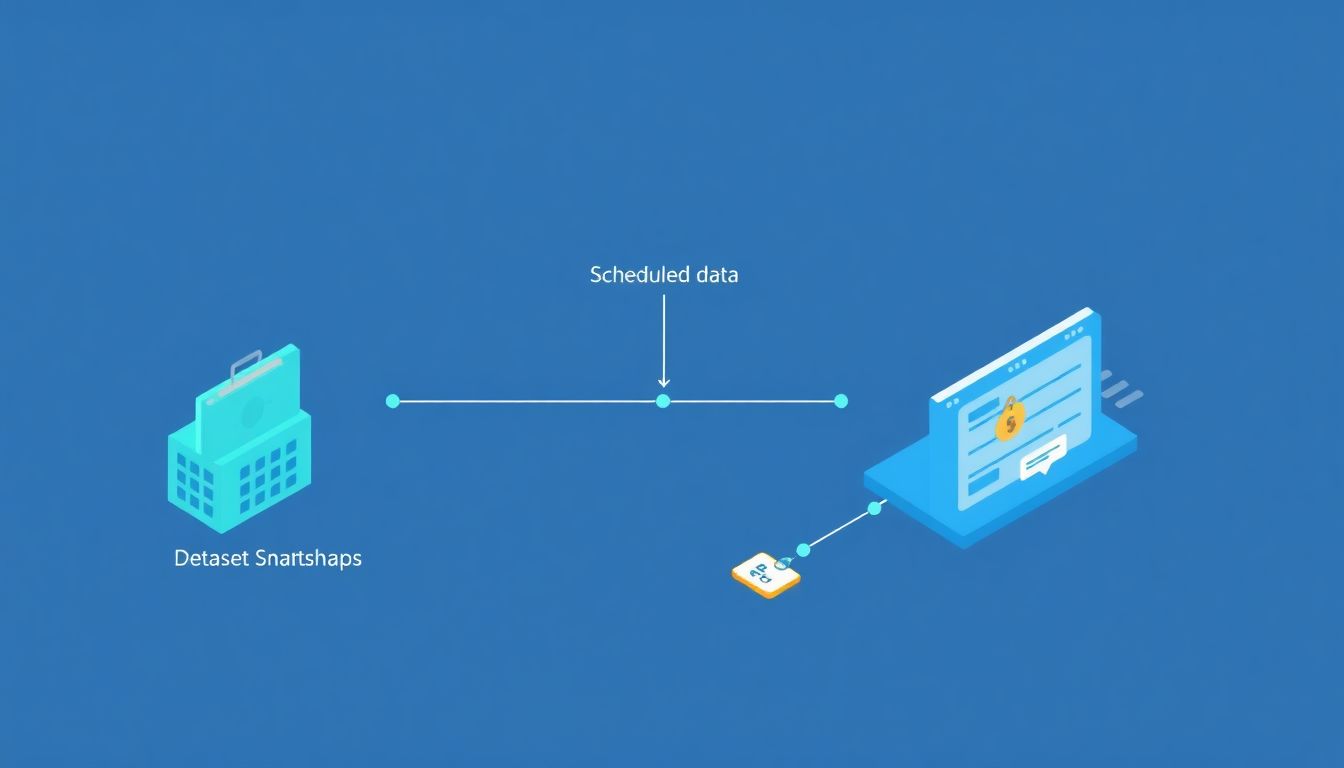
datavibes collects and generates versioned datasets on a schedule; the VBWD dataset plugin catalogues, gates and sells them via an entitlement-keyed API with an SEO page per dataset. Together they are a self-hosted data-product business.
Many businesses sit near valuable data but never monetise it, because the path from collection to a paid API is a stack of unglamorous engineering. VBWD splits that path into two focused tools.
Data is a product — if you can collect it, package it, and charge for it
Plenty of businesses sit on, or near, valuable data — pricing trends, environmental readings, market shares, regional statistics — and never turn it into revenue, because the path from “we could gather this” to “customers pay us for it monthly” is a stack of unglamorous engineering: collection, cleaning, versioning, delivery, access control, and billing. VBWD splits that path into two focused pieces — datavibes for producing datasets and the dataset plugin for selling them — so you can run a data product without building the plumbing from scratch.
datavibes: the data generator
datavibes is a config-driven toolkit whose single job is to produce datasets. It pulls data from public sources, normalises and derives it, and emits a ready-made, versioned dataset — timestamped snapshots you can hand to anything downstream. It is deliberately simple: no web server, no database, no billing inside it. Given a dataset’s configuration and a point in time, it produces the same dataset every time. That determinism is the point — a data product people pay for has to be reproducible, not a one-off scrape that no one can regenerate.
Each dataset is defined declaratively: a small configuration plus, where needed, a tiny adapter for its specific source. You run it two ways from one codebase. As a command you schedule — a cron job (for example, a GitHub Action) runs it on an interval and captures the fresh snapshot — or as a library another Python program imports to drive the same pipeline in-process. The result is a growing series of clean, dated snapshots for each dataset: the raw material of a data business.
Inside VBWD this shows up as a Data Generator admin panel. You manage profiles — each a named dataset with a slug, title, category, row count, and its latest snapshot — and you manage their schedules with cron expressions: enable or disable a profile, see its last run and next fire time, check whether the last run succeeded, or trigger a run on demand. In other words, the collection side becomes an operational surface you watch and control, not a pile of scripts you hope still work.
The dataset plugin: the storefront and the delivery
Producing snapshots is half the business; the other half is selling access to them, and that is what the dataset plugin does. It consumes the files datavibes produces and turns each dataset into something you can monetise. A dataset is modelled as a priceable item: a customer buys it, the purchase grants an entitlement, and the entitlement unlocks API access to the data. The billing, tax, and invoicing all run through VBWD’s unified pricing and subscription engine, so a dataset is sold with the same machinery as any other product on the platform — one-off, or on a recurring subscription for continuously-updated data.
Just as important for actually getting customers: every dataset can carry its own SEO metadata and get its own indexable landing page. Instead of one generic “datasets” page, each dataset has a real URL that describes what it contains and can rank in search — so buyers discover the specific dataset they need. Because VBWD serves crawlable pages for its single-page frontend, those per-dataset pages are visible to search engines, not just to logged-in users.
How the two fit together
The division of labour is clean, and it is what makes the whole thing maintainable:
- datavibes collects and generates — on a schedule, deterministically — and emits versioned snapshots. It knows nothing about money.
- the dataset plugin catalogues those snapshots, gates them behind entitlements, serves them over an API, gives each one a sellable page, and handles the billing.
- the rest of VBWD — accounts, subscriptions, invoices, the agnostic plugin core — carries everything around them.
You can run either half on its own. Use datavibes purely internally to feed your own dashboards, reports, or AI assistants; or use the dataset plugin to sell data you already have. Together, they are a self-hosted “data product” business: collect on a schedule, publish snapshots, sell API access, and let each dataset earn its own search traffic.
Business models this unlocks
The same two pieces support several ways to make money, and you can mix them:
- Subscription data feeds. A dataset that refreshes on a schedule is a natural subscription: customers pay monthly for continuous access to the latest snapshots via the API. Recurring revenue from something a cron job maintains.
- One-off dataset sales. For point-in-time data — a full historical archive, a specific snapshot — sell it once with entitlement-gated download or API access.
- Freemium and samples. Publish a small or delayed snapshot free to rank in search and prove value, and gate the full resolution, full history, or real-time feed behind payment. The free sample is your marketing; the entitlement is your paywall.
- Data-as-an-API. Because access is delivered through an API keyed to an entitlement, your buyers are developers integrating your data into their own products — a higher-value, stickier customer than a one-time download.
- Vertical data products. Curate datasets for a specific audience — environmental and air-quality readings for a wellness or property brand, energy and renewable-share figures for a sustainability consultancy, regional weather or mobility statistics for a logistics tool. A focused, well-maintained vertical dataset beats a generic dump.
- Internal leverage. Even with nothing for sale, feeding clean, versioned data into your own analytics and reporting removes a recurring manual chore and makes your numbers reproducible.
A worked example
Say you want to sell an environmental dataset — air-quality readings by region. You define a datavibes profile that pulls from the public source, normalises it into a consistent schema, and derives the fields you care about. You schedule it to run daily, so each morning a new timestamped snapshot lands. In the dataset plugin you publish that profile as a product: a monthly subscription for API access to the latest data, plus a one-off price for the full historical archive. You give it an SEO page describing exactly what it covers, so a business searching for regional air-quality data finds your page and subscribes. From then on, the cron job maintains the product and the platform handles discovery, entitlement, delivery, and billing. Your ongoing work is curation and quality, not plumbing.
The honest limits
A data business has real responsibilities the software cannot discharge for you. First, rights: datavibes pulls from public sources, but “public” is not the same as “free to redistribute or resell” — you are responsible for confirming you have the right to package and sell any derived dataset, and for respecting each source’s terms and licence. Second, quality and liability: determinism means datavibes reproduces a dataset faithfully, but if the upstream source is wrong or changes shape, your dataset inherits that — you own data quality, documentation, and any accuracy claims you make to customers. Third, operations: this is self-hosted, so you run the schedules, storage, and API, and you own uptime and backups. What the platform gives you is the technical path from collection to paid API; the editorial judgement, the source licences, and the trust you build with buyers are yours.
Takeaway
Turning data into a product usually stalls on engineering no one wants to build. VBWD removes that blocker by separating the job cleanly: datavibes produces versioned datasets on a schedule, deterministically, from simple configuration; the dataset plugin catalogues them, gates them behind entitlements, serves them over an API, and gives each one a sellable, searchable page — all billed through the platform’s subscription engine, all self-hosted, all yours. If your business sits near data worth paying for, the path from “we could collect this” to “customers subscribe to it” is now a configuration and a cron schedule, not a project.
Learn more about VBWD
VBWD is a self-hosted, source-available platform for building subscription products, marketplaces, and AI-powered apps. Explore it further:
- 🌐 Website and documentation: vbwd.cc — see the plugins, architecture, and developer docs.
- 💻 Source code and plugins on GitHub: github.com/VBWD-platform
- 🎥 Watch VBWD in action: demo video 1 and demo video 2
- 💼 Follow the project on LinkedIn: linkedin.com/company/vbwd