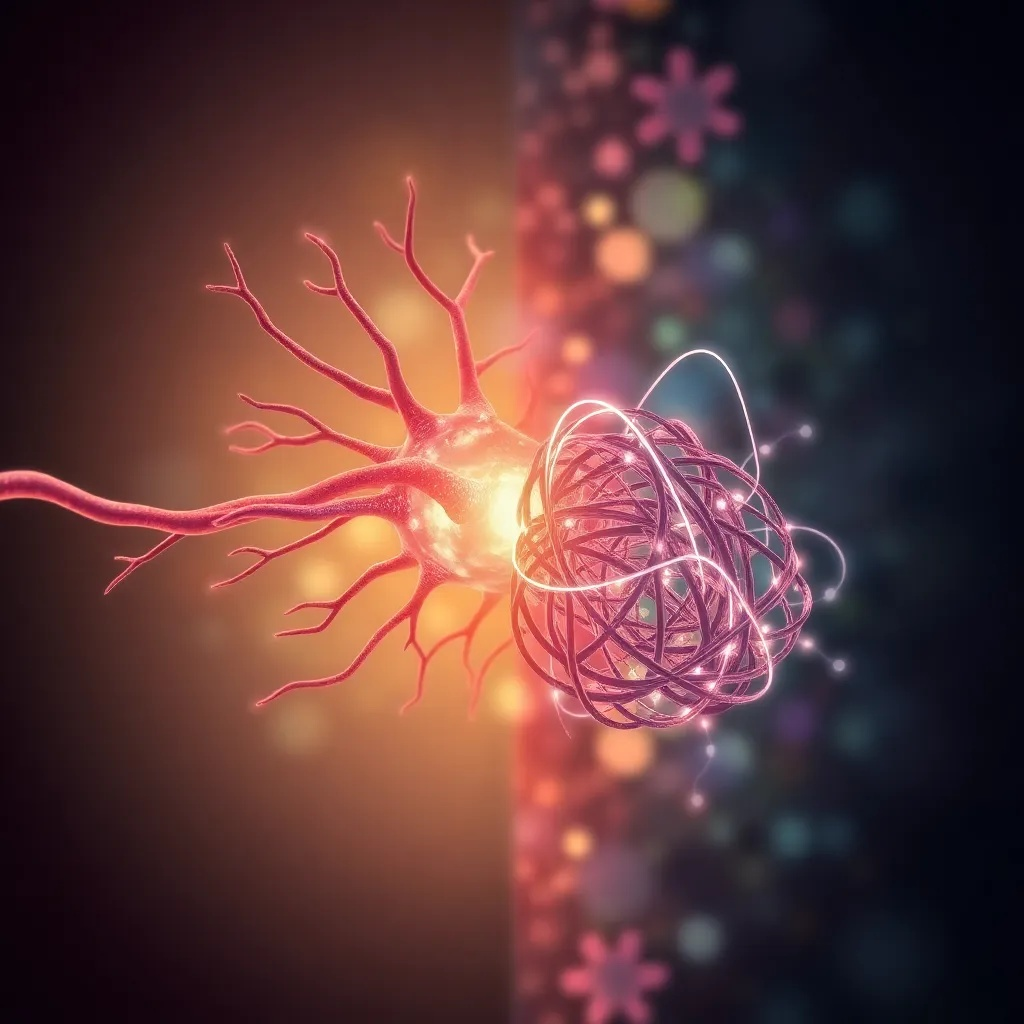
New research reveals tau is crucial for memory encoding, urging a balanced approach in Alzheimer’s therapies to preserve healthy tau.
Tau, long vilified in Alzheimer’s, is actually vital for forming lasting memories, a new study shows.
For decades, tau protein has been cast as a villain in Alzheimer’s disease, its accumulation into neurofibrillary tangles blamed for destroying neurons and erasing memories. But a paradigm-shifting study published on lifespan.io turns that narrative on its head: tau is not merely a pathological agent—it is an essential component for encoding long-term memory. The research, conducted by a team of neuroscientists, reveals that tau protein, specifically when phosphorylated at a site called T205, is required for the stabilization and precise retrieval of memory engrams. This finding has profound implications for Alzheimer’s therapy, suggesting that treatments aimed at eliminating tau must be carefully calibrated to avoid depleting the healthy protein necessary for memory formation.
Study Design: Dissecting Memory in Tau-Deficient Mice
The researchers employed transgenic mice lacking the tau gene (Tau-KO). These mice underwent a series of memory tasks. While their short-term memory—lasting minutes to hours—remained intact, they showed a striking deficit in long-term memory consolidation. For example, when placed in a novel environment, Tau-KO mice explored normally, but 24 hours later, they failed to recognize the familiar context, indicating impaired long-term retention. Control mice with normal tau performed as expected. The study pinpointed the molecular mechanism: in wild-type mice, tau becomes phosphorylated at residue T205 during learning, and this modification is necessary for the stabilization of newly formed memory engrams—the physical representation of a memory in the brain. In Tau-KO mice, this process is absent, leading to memories that are formed but not properly stored.
According to the lifespan.io report, “The phosphorylation of tau at T205 acts as a molecular switch that allows engrams to become resistant to degradation over time.” Without it, the engrams remain fragile and fail to consolidate into long-term storage. The study also demonstrated that artificially inducing tau phosphorylation at T205 in Tau-KO mice restored long-term memory formation, confirming the causal role.
Why This Matters for Alzheimer’s Therapeutics
Current Alzheimer’s drug development has focused heavily on reducing tau pathology—either by preventing aggregation, promoting clearance, or using antisense oligonucleotides to lower total tau levels. However, if tau is essential for memory, then broadly reducing tau could inadvertently harm cognitive function. The authors emphasize, “Therapies that non-specifically deplete tau may worsen the very symptoms they aim to treat. A more targeted approach is needed to eliminate only the toxic aggregates while preserving soluble, functional tau.” This is particularly relevant given recent failed clinical trials for tau-lowering drugs, which may have overlooked this fundamental dichotomy.
Additionally, the study offers a hopeful perspective on memory loss in tauopathies. “Memories thought to be erased may merely be inaccessible due to disrupted tau function,” the authors note. “Restoring healthy tau signaling could potentially allow retrieval of ‘lost’ memories.” This aligns with earlier research showing that in early Alzheimer’s, engrams may still exist but are not properly activated.
The Bigger Picture: Rethinking Tau’s Role in the Brain
This discovery is part of a broader reevaluation of proteins traditionally seen as pathological. For decades, the amyloid cascade hypothesis dominated Alzheimer’s research, with tau considered a downstream executor of toxicity. However, patient outcomes from anti-amyloid therapies have been modest, shifting focus to tau. The new findings suggest that tau’s normal function must be understood before we can safely intervene.
The study also highlights tau’s role in synaptic plasticity. Previous work had indicated tau influences microtubule stability and axonal transport, but its involvement in memory encoding was not clearly defined. By linking a specific phosphorylation site (T205) to engram stabilization, this research provides a precise molecular target for future studies.
Looking back, the historical context of tau-targeted therapies underscores the need for caution. In the early 2000s, several drugs aimed at inhibiting tau aggregation (e.g., methylene blue derivatives) showed mixed results in trials. More recently, tau antisense oligonucleotides (e.g., IONIS-MAPTRx) have entered clinical testing, designed to reduce tau production. The new data suggest that such approaches might be effective only if they spare the T205-phosphorylated pool of tau, or if they are applied at very early stages when tau function remains intact.
Similarly, the trend toward precision medicine in neurodegeneration aligns with this study’s message. Just as in cancer, where therapies must distinguish between healthy and malignant cells, Alzheimer’s treatments must differentiate between beneficial and harmful tau. This could involve designing molecules that recognize the conformation of tau aggregates without disrupting native tau, or promoting post-translational modifications that enhance tau’s protective functions.
In conclusion, the lifespan.io study marks a turning point in our understanding of tau. It calls for a more nuanced therapeutic strategy—one that does not throw out the baby with the bathwater. By preserving tau’s essential role in memory, future interventions may be able to halt Alzheimer’s progression without sacrificing the very essence of our cognitive selves.