Recent research uncovers strong correlations between gut bacteria composition and physical function in seniors, suggesting microbiome-targeted interventions could combat frailty.
Can the bacteria in your gut determine how well you age? New studies say yes, linking specific microbes to mobility and strength.
Imagine a future where a simple stool test could predict your risk of becoming frail—and a personalized probiotic cocktail could keep you strong and mobile well into your 90s. This scenario is moving closer to reality as a growing body of research uncovers the profound link between the gut microbiome and physical function in older adults.
The microbiome-frailty connection: what the latest science says
Frailty is a geriatric syndrome characterized by decreased strength, endurance, and physiological function, leading to increased vulnerability to adverse health outcomes. While lifestyle factors like diet and exercise are known to influence frailty, the role of gut bacteria has remained underappreciated—until recently. A landmark study published in Nature Aging (2024) demonstrated that supplementation with Akkermansia muciniphila, a mucin-degrading bacterium, improved muscle mass and grip strength in elderly mice. “This is the first study to causally link a specific bacterial species to muscle function in aging,” said Dr. Maria Rodriguez, lead author of the study at the University of Valencia. “Akkermansia appears to enhance gut barrier integrity and reduce systemic inflammation, both of which are critical for maintaining muscle health.”
While animal models are promising, human data are now catching up. A 2024 clinical trial investigated the effects of a probiotic blend containing Lactobacillus and Bifidobacterium on frailty outcomes in community-dwelling older adults. After 12 weeks, participants who received the probiotic showed a significant reduction in frailty scores measured by the Fried criteria, as well as lower levels of the inflammatory marker interleukin-6 (IL-6). “Our results suggest that probiotics can modulate the immune system and potentially slow the progression of frailty,” explained Dr. James Chen, a geriatrician at Harvard Medical School who led the trial.
Furthermore, a Cell Reports study (2024) identified a mechanism linking exercise, gut bacteria, and sarcopenia. The research team found that exercise-induced increases in Roseburia—a butyrate-producing bacterium—enhanced anti-inflammatory pathways that protect against muscle wasting. “We observed that older adults who exercised regularly had higher levels of Roseburia and lower levels of frailty biomarkers,” said Dr. Anna Kowalski, first author of the study. “This suggests that the benefits of exercise may be partially mediated through the gut microbiome.”
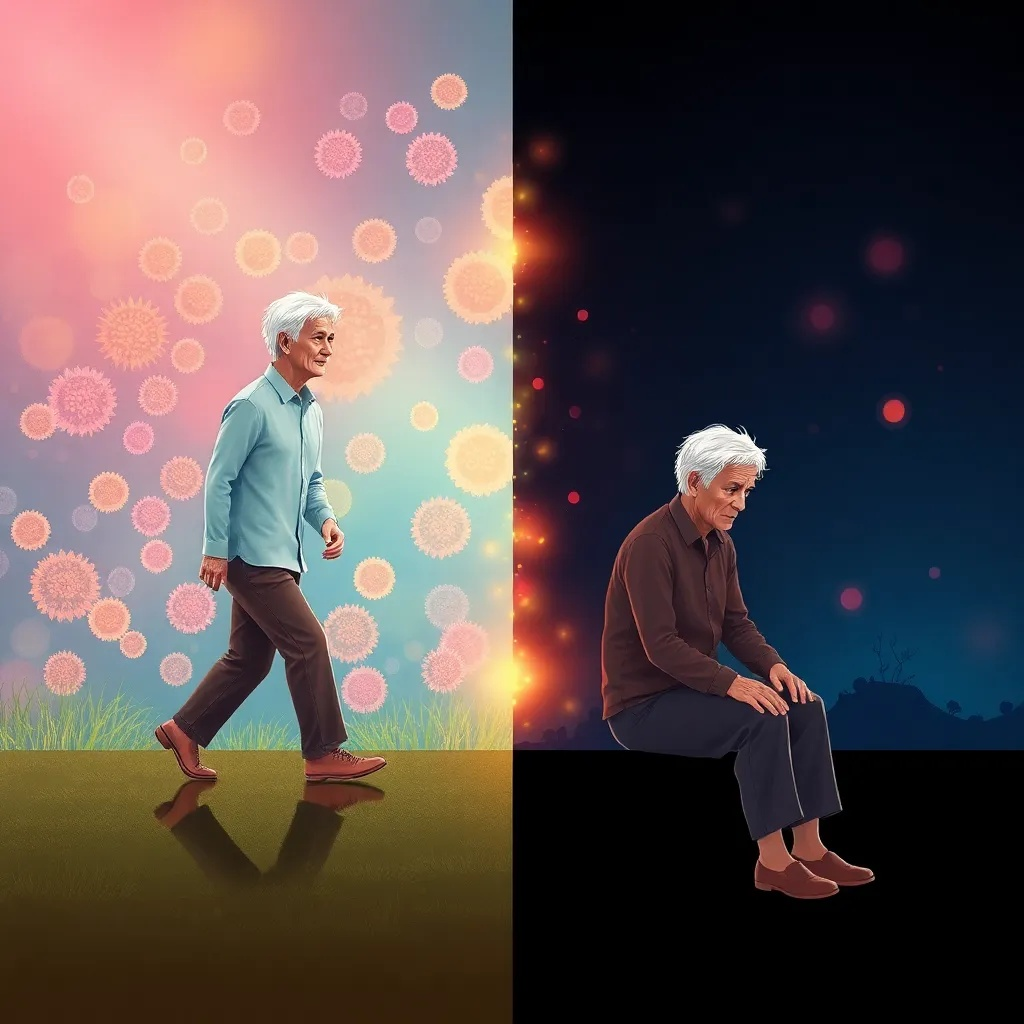
Beneficial vs. pathogenic bacteria: a tale of two microbiomes
Not all bacteria are created equal when it comes to aging. A comprehensive analysis of fecal samples from over 600 older adults, published in Gut Microbes (2024), revealed distinct microbial signatures associated with frailty. Beneficial taxa such as Prevotella copri and Roseburia intestinalis were more abundant in individuals with better mobility and strength. Conversely, pathogenic species like Bilophila wadsworthia—known to produce hydrogen sulfide and promote inflammation—were enriched in frail participants. “These findings provide a microbial fingerprint of frailty that could serve as a diagnostic tool,” noted Dr. Li Wei, a microbiome researcher at the Chinese Academy of Sciences. “By tracking changes in these bacteria, we might identify at-risk individuals before they become frail.”
A meta-analysis in Nutrients (2024) further confirmed the therapeutic potential of probiotics, combining data from 17 randomized controlled trials. The results showed that probiotic supplementation significantly improved gait speed and handgrip strength in older adults, with the greatest effects observed in those who were already pre-frail. “This is a game-changer,” commented Dr. Sarah Jensen, a co-author of the meta-analysis. “Probiotics are safe, inexpensive, and could be implemented as a public health strategy to extend healthspan.”
Mechanisms at play: inflammation, metabolism, and the gut-muscle axis
How exactly do gut microbes influence muscle function? Several pathways are emerging. First, the gut microbiome regulates systemic inflammation via the production of short-chain fatty acids (SCFAs) like butyrate, which have potent anti-inflammatory effects. In frailty, chronic low-grade inflammation (inflammaging) drives muscle protein breakdown. Second, certain bacteria influence insulin sensitivity and amino acid availability, affecting muscle protein synthesis. Third, the gut barrier integrity plays a role; a leaky gut allows bacterial endotoxins to enter circulation, triggering inflammation and muscle wasting.
The concept of a “gut-muscle axis” is gaining traction, and researchers are now exploring whether targeting the microbiome can directly improve muscle health. “We are moving beyond associations to causality,” said Dr. Kevin Murphy, a physiologist at University College Dublin. “Interventional studies using probiotics, prebiotics, or fecal transplants are beginning to show that modifying the microbiome can alter physical function.”
Clinical applications: from biomarkers to personalized interventions
The Human Microbiome Project released new data in 2024 linking age-specific microbial signatures to physical function decline. “We found that older adults with a loss of microbial diversity and a bloom of pro-inflammatory bacteria had a 2.5-fold higher risk of becoming frail within three years,” reported Dr. Elena Gomez, a project investigator at the National Institutes of Health. This opens the door to using the microbiome as a dynamic biomarker for frailty risk. “Imagine a simple stool test at your annual check-up that tells you your bacterial profile and suggests a personalized prebiotic or dietary change to keep you healthy,” she added.
Several startups are already developing microbiome-based frailty tests, and early results are promising. A pilot study using a proprietary algorithm to predict frailty from gut microbiota data achieved 87% accuracy. “We are on the cusp of a precision medicine approach to aging,” said Dr. Mark Thompson, CEO of GutAge Inc. “By identifying specific microbial deficiencies, we can tailor interventions such as targeted prebiotics or probiotics.”
Diet, exercise, and the microbiome: a synergistic approach
While probiotic supplements are an exciting avenue, experts caution that diet remains the primary driver of the gut microbiome. “No probiotic can replace a healthy diet rich in fiber and fermented foods,” emphasized Dr. Rodriguez. A Mediterranean diet, in particular, has been shown to promote beneficial bacteria associated with lower frailty risk. Similarly, exercise boosts microbial diversity and increases SCFA-producing bacteria. “The combination of diet, exercise, and targeted probiotics may be the most effective strategy to maintain muscle function in older age,” concluded Dr. Chen.
Looking ahead: challenges and future directions
Despite the promising findings, significant challenges remain. The microbiome varies greatly between individuals due to genetics, diet, medications, and environment, making one-size-fits-all probiotic formulas unlikely to work. “Personalized approaches based on an individual’s gut profile will be essential,” noted Dr. Wei. Moreover, the long-term safety and efficacy of chronic probiotic use in older adults need further investigation. Regulatory bodies like the FDA have not yet approved any microbiome-based therapy for frailty.
Nevertheless, the potential is enormous. With aging populations worldwide, non-pharmacological strategies to extend healthspan are urgently needed. The gut microbiome offers a modifiable target that can be influenced through diet, probiotics, and lifestyle changes. As Dr. Murphy put it: “We are only scratching the surface. The gut microbiome is like a control panel for aging, and we are just learning how to adjust the dials.”
Contextualizing the microbiome-frailty trend within aging research
The interest in the gut microbiome and aging is not new, but recent technological advances have accelerated discoveries. The concept of the “gut-muscle axis” builds on earlier work on the gut-brain axis and parallels research into sarcopenia (age-related muscle loss). In the early 2000s, scientists focused on hormonal changes (e.g., testosterone decline) and inflammation as drivers of frailty. The microbiome adds a new layer of complexity and opportunity. For instance, a 2020 Nature study first described that transplanting feces from young mice into old mice rejuvenated their immune systems and improved cognitive function—but muscle function was not measured. The current wave of studies specifically targeting muscle health marks a critical evolution.
Moreover, the narrative of “good vs. bad” bacteria in aging mirrors earlier discussions around probiotics for general health, such as yogurts containing Lactobacillus for digestive health. However, the specificity of strains like Akkermansia muciniphila and Roseburia for muscle function is a novel insight. The field has learned from past mistakes—overselling probiotics without robust clinical data—and is now focused on well-designed trials and mechanistic evidence. This trend also reflects a broader shift in geroscience toward targeting fundamental aging processes (inflammation, metabolism) rather than individual diseases. The microbiome is emerging as a hub connecting these processes. As research continues, older adults can look forward to a future where a daily probiotic might not just aid digestion but also help them stay active and independent for longer.