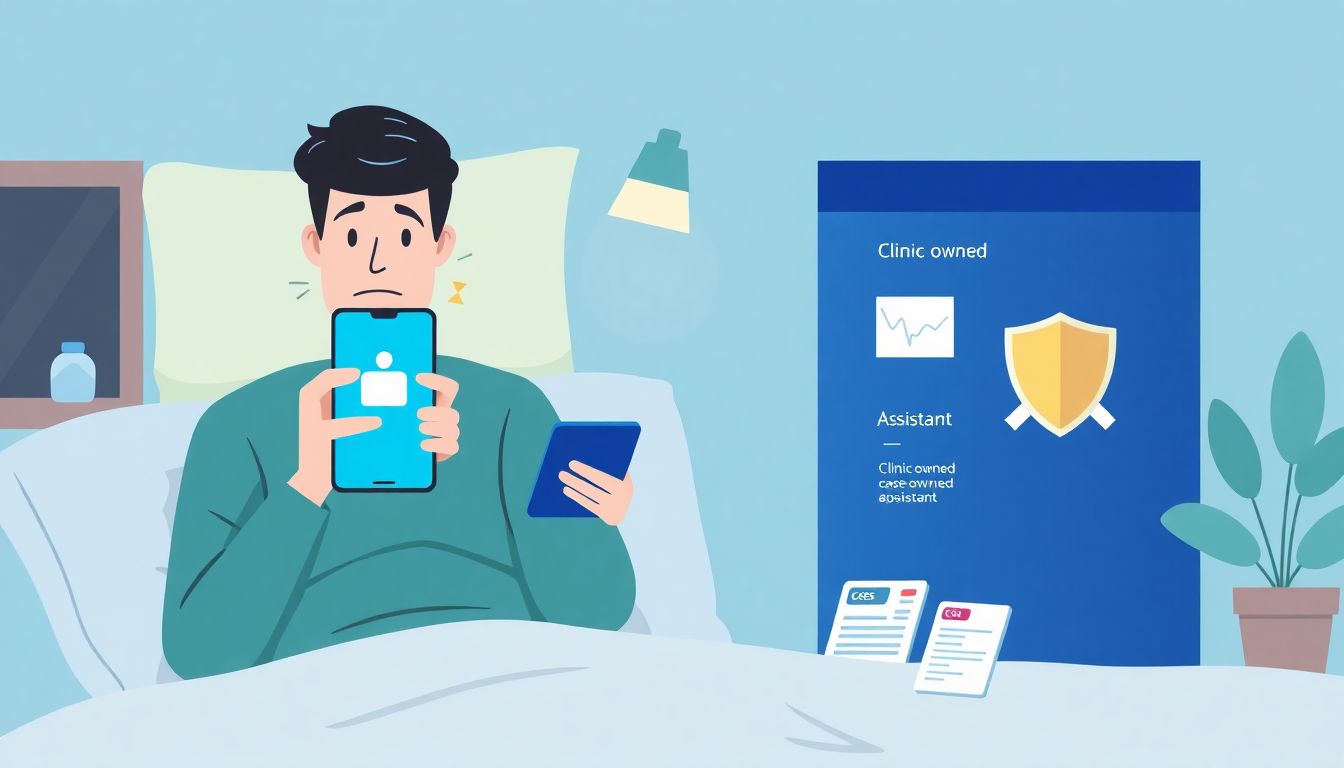
A Nature Health study of 617,827 Copilot conversations found 40.8% seeking health education, 14.5% asking on behalf of a child or elderly parent — and that chatbots ‘can fail in triage.’ Patients won’t stop. The realistic response: a vetted, self-hosted assistant grounded in your own content, with the diagnostic line firmly held.
You can’t ban patients off AI health tools. You can offer a better, grounded, owned version.
In a single month, people had more than 600,000 conversations about their health with one general-purpose AI chatbot. Not with a doctor. Not with a medical service. With Microsoft Copilot — the same assistant they use to draft emails. A new study in Nature Health looked at what those conversations actually contained, and the findings should reshape how clinics think about the AI their patients are already using.
What people are actually asking
The researchers (Costa-Gomes et al., Microsoft AI) analysed 617,827 health-related conversations from January 2026. The breakdown is revealing:
- 40.8% sought general health education — non-personal questions about conditions and treatments.
- Around 20% described personal symptoms, interpreted test results, or managed a condition.
- 14.5% asked about symptoms on behalf of someone else — a child, an elderly parent, a partner. Roughly one in seven health questions is about a dependent.
- Mobile users asked about symptoms more than twice as often as desktop users (15.9% vs 6.9%).
- Evening and nighttime queries carried more emotional-wellbeing concern than morning ones.
Read those numbers as a clinician and a picture forms: a worried parent at 11pm, on a phone, typing a child’s symptoms into a general chatbot because the surgery is closed and the emergency line feels like too much. That’s not misuse. That’s a real human need meeting the only tool that’s awake.
The problem the study names
Here’s the uncomfortable finding. The researchers are blunt that conversational AI “can fail in triage settings,” and that users sometimes do no better at identifying a condition than they would without it. Their key line deserves to be quoted in every hospital IT meeting: “strong benchmark performance does not always translate to real-world reliability.”
A general chatbot can pass medical exams and still give a frightened parent the wrong steer at midnight — because a benchmark is a clean question and a scared person at 11pm is a messy one. The model wasn’t built for triage, isn’t accountable for the answer, and has no idea what your local services, your protocols, or this specific patient’s history actually are.
And there’s a second problem the healthcare sector feels more sharply: those 600,000 conversations, full of symptoms and test results, happened on a general consumer platform. That’s a lot of intimate health information flowing somewhere a clinic doesn’t control and can’t see.
The realistic response isn’t “tell patients to stop”
Patients will not stop. The convenience is overwhelming and the need is genuine, especially out of hours and for the one-in-seven questions asked on behalf of someone who can’t ask themselves. Telling people not to use AI for health is telling the tide not to come in.
The realistic response is to give them a better version of the thing they’re already reaching for — one grounded in vetted content, controlled by clinicians, and running where the data stays put.
Where a self-hosted, grounded assistant fits
This is where infrastructure like VBWD becomes relevant — and it’s worth being precise, because health is exactly the domain where vague claims do harm. VBWD is a self-hosted, source-available platform, not a medical device and not a diagnostic tool. What it provides is the layer underneath a health information service that a clinic or health organisation runs itself.
Three properties of that layer map directly onto the study’s findings:
Grounded, not general. VBWD’s assistant plugins answer from a document corpus you supply — your vetted patient-education material, your prep instructions, your local service information — using retrieval over your own content rather than a model’s open-ended guesswork. The difference between a general chatbot and one that can only answer from clinician-approved material is the difference between “the model’s best guess” and “what your clinic actually says.”
Your data stays yours. Because it’s self-hosted, those conversations happen on infrastructure the organisation controls, in a chosen jurisdiction — not on a consumer platform. The 600,000-conversations-somewhere-else problem becomes conversations on your own system.
Boundaries you enforce. A grounded assistant scoped to administrative and educational content — opening hours, preparation instructions, “here’s what our clinic advises about this,” when to seek care — is a genuinely useful tool. It is emphatically not a triage or diagnostic system, and the study is a strong argument for keeping that line bright.
The line that must not be crossed
Let this be unambiguous, because the Nature Health findings demand it: an AI assistant answering “what does our clinic advise about a fever in a toddler, and when should you go to A&E” is an administrative and educational tool. An AI assistant deciding whether a specific child is sick is a regulated clinical activity, and this study is direct evidence that general chatbots fail at exactly that. Grounding and self-hosting improve safety and privacy; they do not turn an information service into a clinician. No infrastructure does.
The takeaway
Six hundred thousand health conversations a month with a general assistant is not a problem you can ban your way out of. It’s a signal: people want fast, private, always-available health information, and they’ll take it from whatever’s nearest. The constructive move for a clinic isn’t to fight that — it’s to offer a version grounded in its own vetted content, running on its own infrastructure, with the diagnostic line firmly held. Meet the need the study documents, without inheriting the failure mode it warns about.
General information for healthcare and technology decision-makers, not medical, legal, or regulatory advice. AI information tools are not a substitute for professional medical assessment; deployment in any clinical setting requires appropriate validation, governance, and compliance review. Study: Costa-Gomes et al., Nature Health, 2026.