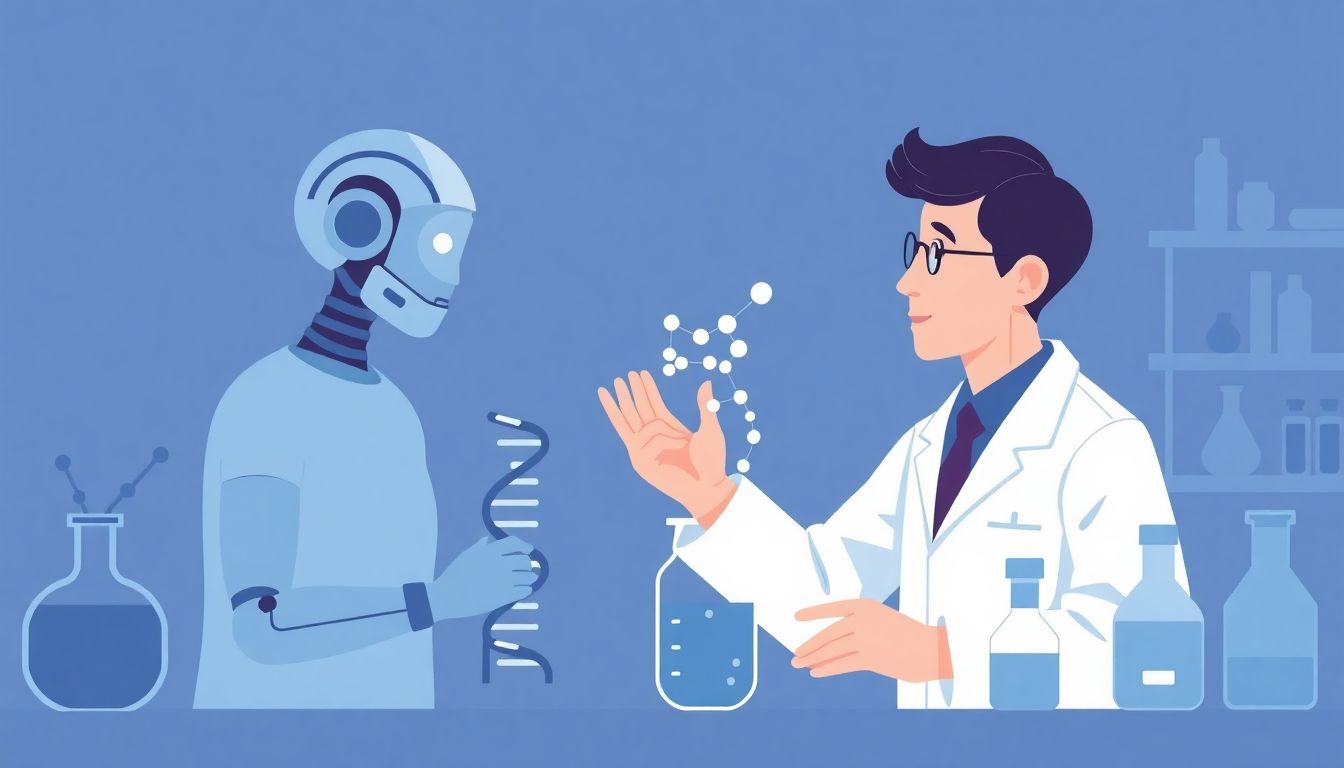
Anthropic launched Claude Science — an AI workbench for researchers — and announced it will run its own drug-discovery programs for neglected diseases, aiming to compress R&D tenfold. What it could mean for patients, and the healthy skepticism to keep.
Health news explainer.
The AI company whose tools help programmers write software now wants to help scientists discover drugs — and, more surprisingly, it wants to discover some itself. In mid-2026 Anthropic unveiled Claude Science, an AI “workbench” for researchers, and announced it would run its own preclinical drug-discovery programs. It is one of the clearest signs yet that the same AI wave reshaping software is arriving in the laboratory.
What Claude Science is
Anthropic pitched the product, launched at an event on 30 June 2026, as doing for scientific research what its Claude Code tool does for engineering: given a concise, high-level instruction, it can autonomously carry out meaningful chunks of work. As MIT Technology Review described it, Claude Science is aimed at unifying the fragmented tangle of tools a drug researcher juggles — data, models, lab systems — into one workflow an AI can help drive. The ambition Anthropic has stated is blunt: compress the life-sciences R&D timeline by roughly a factor of ten.
The twist: Anthropic wants to make its own medicines
The more eye-catching move is that Anthropic is not just selling a tool to drugmakers — it is becoming one, in a narrow sense. The company said it would run internal preclinical programs focused on neglected diseases, including rare conditions that traditional pharmaceutical companies often skip because the economics are unattractive, per reporting from CNBC. It has reportedly been hiring biologists and building lab capacity to do it. The logic is that if AI genuinely lowers the cost of early discovery, targets that were never worth a big company’s time might suddenly pencil out.
Not a side project
The scale of the surrounding moves suggests this is a serious bet, not a demo. Anthropic struck a collaboration with pharmaceutical giant Bristol Myers Squibb to roll Claude out to tens of thousands of employees, the chief executive of Novartis joined its board, and the company acquired an AI-biotech startup, Coefficient Bio, reportedly for around $400 million, according to industry coverage. When a leading AI lab hires wet-lab biologists and buys a biotech, it is telling you where it thinks the next frontier is.
What it could mean for patients — eventually
For readers, the honest translation is “promising, and slow.” Drug discovery has many stages, and AI is strongest at the earliest ones — sifting literature, generating hypotheses, designing candidate molecules, integrating messy data. The long, expensive, human parts — safety, clinical trials, regulation — still take years and still fail often. AI compressing the front of that pipeline is genuinely valuable, especially for neglected and rare diseases that have been starved of investment, but it does not shorten a clinical trial or guarantee a candidate works in people.
The healthy skepticism
There are real questions to hold alongside the optimism. Bold timelines — a tenfold speed-up — are easy to announce and hard to prove; the field has seen AI-for-drug-discovery hype before. Letting AI propose molecules raises questions about validation, reproducibility, and who is accountable when a model is confidently wrong. And an AI company running its own drug programs blurs lines the industry will have to think through. None of that makes the effort unserious; it makes it worth watching closely rather than cheering blindly.
Why it matters
The significance is less any single molecule and more the shift it represents: the tools that made software cheap to build are now being pointed at biology, backed by real money, real partnerships, and a stated goal of tackling the diseases the market has ignored. If even part of that promise holds, the people who benefit most would be patients with rare and neglected conditions who have waited longest for anyone to try. That is a story worth following through the hype — carefully, and with hope.
General information, not medical advice. Early-stage research and forward-looking claims are uncertain by nature; timelines and outcomes may change. Sources are linked above.