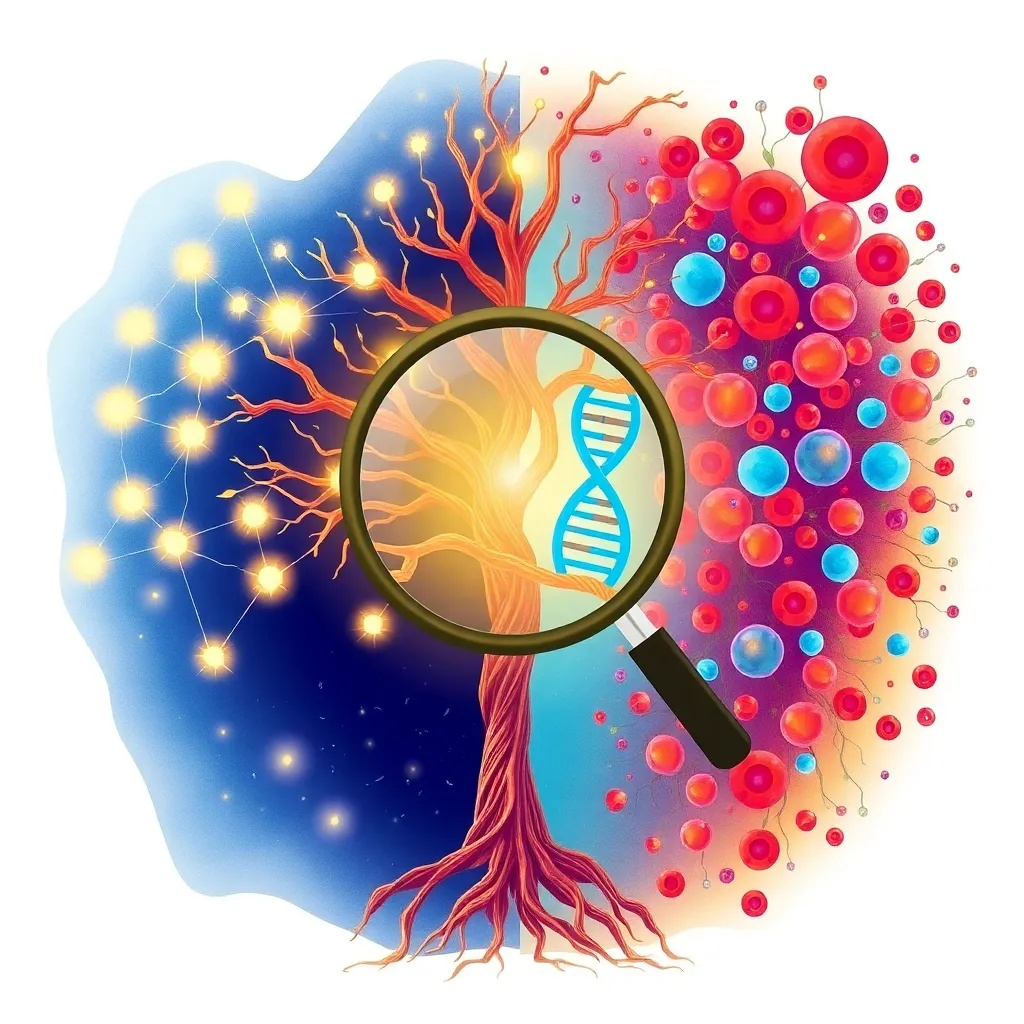
New research reveals an inverse relationship between cancer and neurodegenerative diseases, offering evolutionary insights for dual therapies targeting healthy aging.
Could the same biological pathways that protect against cancer also increase neurodegeneration risk? Recent studies suggest a complex trade-off rooted in evolution.
The Inverse Comorbidity Phenomenon
Epidemiological data consistently show an inverse relationship between cancer risk and neurodegenerative disease risk. A recent review in the International Journal of Molecular Sciences (2024) consolidates evidence on this inverse comorbidity, highlighting shared pathways such as p53, PI3K/AKT/mTOR, and Wnt signaling. These pathways govern a cellular trade-off between proliferation (cancer risk) and maintenance (neuroprotection).
Shared Pathways: p53, mTOR, and Wnt
p53, a tumor suppressor, is often mutated in cancer but hyperactive in some neurodegenerative conditions. The PI3K/AKT/mTOR pathway promotes cell growth but when overactive, it can contribute to both cancer and neurodegeneration. Wnt signaling balances stem cell renewal and differentiation, with dysregulation linked to both diseases. Understanding these pathways is key to developing interventions that simultaneously reduce cancer and neurodegeneration.
Lessons from Nature: Naked Mole Rats and Bowhead Whales
Comparative biology offers unique insights. Naked mole rats exhibit remarkable cancer resistance due to enhanced p53 activity and unique extracellular matrix composition. Bowhead whales, which can live over 200 years, possess mutations in DNA repair genes like ERCC1 that reduce cancer risk and may protect against neurodegeneration. These natural adaptations suggest that improving DNA repair and cellular maintenance could be the key to healthy aging.
Cellular Senescence: A Double-Edged Sword
New research implicates cellular senescence in both cancer and neurodegeneration. Senescent cells accumulate with age and secrete inflammatory factors that can promote cancer or damage neurons. Senolytic drugs, which clear senescent cells, show promise as a dual therapy. Early clinical trials are exploring their effects on both cancer prevention and cognitive decline.
Evolutionary Trade-Offs as Roadmap for Drug Development
The evolutionary perspective suggests that targeting shared pathways like mTOR could simultaneously prevent cancer and neurodegeneration. mTOR inhibitors are already used in some cancers and being tested for age-related diseases. However, careful modulation is needed because complete inhibition could impair immune function. Insights from long-lived species may identify novel targets that strike the right balance.
Clinical Implications and Future Directions
Understanding these trade-offs could lead to personalized interventions based on an individual’s genetic risk for cancer or neurodegeneration. For example, people with strong p53 response might be more prone to neurodegeneration and could benefit from therapies that enhance autophagy or reduce senescence. Conversely, those with hyperactive mTOR might need careful monitoring for both cancer and cognitive decline. The review in IJMS emphasizes that evolutionary biology is not just academic—it provides a roadmap for developing therapies that promote healthy aging by addressing both diseases simultaneously.
Analytical Context: The Rise of Dual-Target Therapies
The interest in cancer–neurodegeneration comorbidity has grown since large-scale cohort studies in the early 2010s first highlighted the inverse relationship. Landmark analyses of the Swedish Twin Registry and UK Biobank confirmed that individuals with a history of cancer have a lower risk of developing Alzheimer’s disease, and vice versa. This sparked a wave of research into shared mechanisms, culminating in recent clinical trials of metformin (an mTOR inhibitor) for both cancer prevention and cognitive health. Similarly, senolytic drugs like dasatinib and quercetin have moved from animal studies to human trials for osteoarthritis, but their potential for neurodegeneration is now being explored. The field mirrors earlier efforts to repurpose drugs like statins for Alzheimer’s, but with a stronger biological rationale grounded in evolutionary conservation.
Historical Patterns and Industry Trends
The current focus on senescence and mTOR echoes previous cycles in aging research. In the 1990s, caloric restriction was the dominant paradigm, shown to extend lifespan across species by downregulating growth pathways. The discovery of sirtuins as mediators of caloric restriction led to a wave of supplement development, though clinical translation has been slow. Today, the emphasis is on pharmacological modulation of nutrient-sensing pathways (mTOR, AMPK, insulin/IGF-1) and clearance of senescent cells. The biotechnology industry has responded: companies like Unity Biotechnology are developing senolytics, while others are targeting autophagy. The parallel between these efforts and past attempts (e.g., resveratrol hype) underscores the need for rigorous clinical validation. However, the evolutionary perspective—learning from species that have already solved the cancer–neurodegeneration trade-off—provides a more targeted approach that could avoid previous pitfalls.